Aaron Reitz is the Right Man for AG

I’m not fond of endorsements from famous or connected people. I’ve written about that before. But I do support endorsements from grassroots voters who do their homework and research candidates. In that same blog post, I said “The only endorsement worth anything is that of the voters, your endorsement. You have the power. Don’t be swayed by a list of allegedly important names.

Y’all know I do my homework. I teach a “Data & Research” class. I authored a PPT on how to research candidates.

I’m strongly endorsing Aaron Reitz for Attorney General. Not only is he Ken Paxton’s choice for the next AG, but he has the tenacity, core values, and strength of character to protect Texas and to manage over 4,000 employees.

Three of the four candidates running for TX Attorney General are legislators. I’ve not written about it in detail, but I’ve been vocal about most legislators not making good executives. The skill set is very different.

To net it out: legislators have to convince others to join them in supporting a bill; they have to compromise; they count votes. Executives have to be able to make decisions after gathering facts. They have to think strategically… play chess… and be many moves ahead of their opponents.

That’s the thinking needed for an effective Attorney General. There is only one candidate in this race that has that capability: Aaron Reitz.

Mayes Middleton

Mayes, calling himself MAGA Mayes, has told you that because he helped push a MAGA agenda through the legislature, he should be AG. No, that just shows he shares Trump’s opinions. It shows he can count votes. It doesn’t show he can execute when the going gets tough.

Joan Huffman

Joan cites her prosecutorial and judicial experience. That experience would serve her well working in the AGs office, but not as AG.

Chip Roy

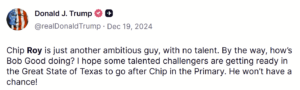
My opinion of Chip Roy is that he’s a political opportunist. He says what he thinks voters want to hear. But a good look at his record shows otherwise. Roy supported Trump’s impeachment. He defended Liz Cheney.

And, in December 2024, Trump posted on Truth Social:

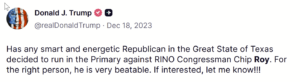
In case you think that was a one-off, just a year earlier, Trump had posted:

My guess is that’s why Roy pivoted and decided to run for AG. He has name recognition and he wouldn’t have Trump after him. So beware the political person who pivots and changes positions with the wind, saying anything he thinks the voters want to hear. That’s the definition of political opportunist. That’s Chip Roy.

In case you don’t know Aaron or haven’t heard him speak, watch this video:

I hope you will join me (and Ken Paxton) in voting for Aaron Reitz for TX Attorney General.

Pervasive Fraud

There are many types of fraud: theft of government property, theft of government services, fraudulent applications for government funds. Some are small… a few hundred dollars here or there. Some are larger… thousands received under false pretenses. Some are massive… millions or billions stolen right in front of our eyes.

I served as the mayor of a small town. I’ve been employed by government. My husband was foreman of a grand jury dealing with political corruption. We’ve seen and experienced a lot.

The fraud in Minnesota comes as no surprise. The scope of it does. Where was someone in government questioning the millions of tax dollars flowing who knows where? Watching all 43 minutes of this video is shocking and eye-opening.

Investigating fraud has nothing to do with skin color or countries of origin. It has to do with character or lack thereof.

I was in office 6 days when one of the largest snowstorms ever hit the northeast. A few weeks later, after thawing and freezing, many homeowners had significant water damage caused by ice thawing and backing up under eaves. An employee was in my office and we were chatting about this. Without blinking an eye, he suggested that to avoid the issue I head over to Public Works and grab a couple of buckets of “ice ban” (used to prevent icing on streets). If I threw it up on my roof, problem solved. He so casually suggested that I steal publicly purchased materials that it was evident to me he saw nothing wrong with it. The minute he left my office, I shared the conversation with his manager and said “If I ever catch that SOB or anyone else stealing from the taxpayers, I’ll fire them on the spot.” That was in 1996. I reported one employee to the county prosecutor with proof of what should have been considered “theft of services”: doing work for a private company on town time. I was informed, in writing, that this “didn’t rise to the level of a crime”.

This is how it goes in government. A little theft here, a little work for a private company there, repairs on a private home in return for help with getting a development approved… blind eyes turned to it all.

Elgin: $6 million taxpayer dollars missing. Bastrop: $25,000 taxpayer funds handed to an alleged non-profit with no subsequent reconciliation.

This is just what we know about. Tip of the iceberg? Likely yes.

I’ve been teaching a “Data & Research” class to teach those who are interested how to obtain, research, parse, and evaluate government data. There are many ways to circumvent transparency. If you’re interested in attending these classes, email me. These are your tax dollars being “inappropriately used”.

Old 71 Lock Up

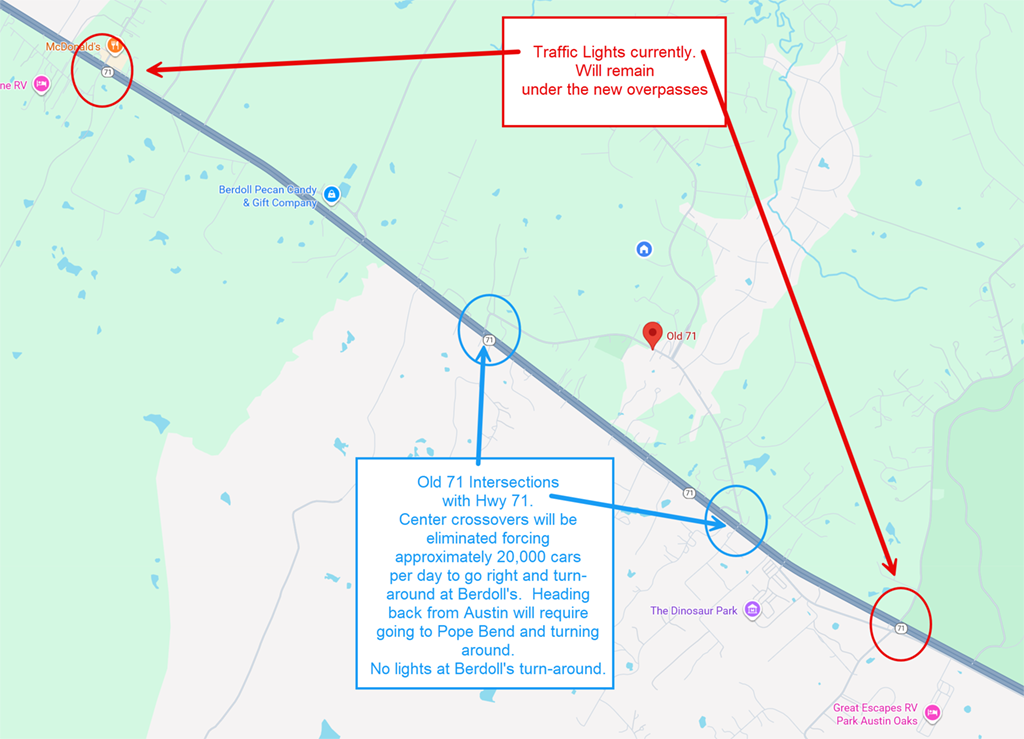
TX Representative Stan Gerdes posted the other day how wonderful it is that the traffic lights will now be eliminated on 71 up to Tucker Hill (McDonalds near Travis County). It’s been funded. That’s great for all the commuters, but what about those of us who live off 71?

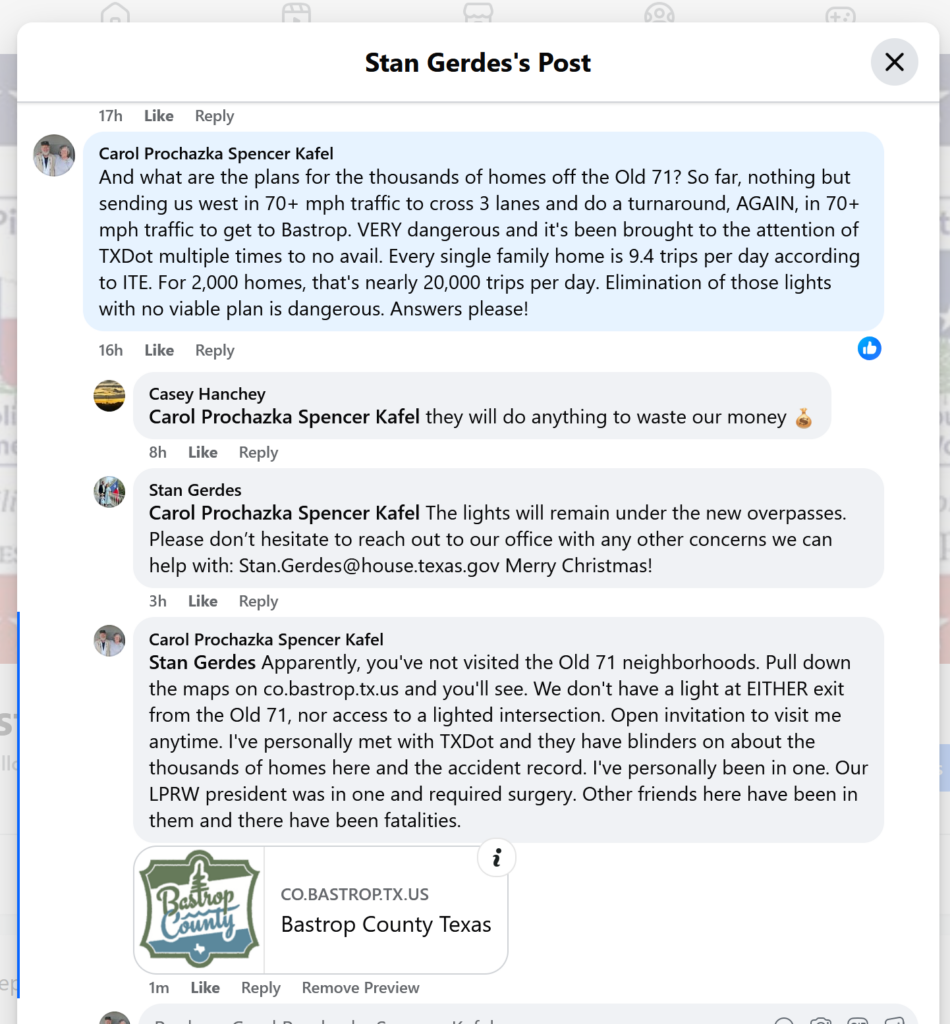
In a shocking exchange on Facebook, it’s obvious to even the most casual observer that our representative has never been to our neighborhood. He’s never had to leave anyone’s house on the Old 71, in River Crossing, in Double Eagle or The Forest at Colorado Crossing.

He couldn’t have even looked at a map before responding because he assured me that the lights would remain under the new overpasses.

So what? The 2 exits from Old 71 have no lights. Nor do they have access to a lighted intersection… anywhere!

I’ve personally met with TXDot, along with representatives from Old 71 neighborhood HOAs. I’ve attended public meetings and years ago, made suggestions. All to deaf ears. I’m not going to rehash what I wrote in my comment on Facebook but suffice it say, we’re stuck.

Representation requires understanding the situation and the complaint. Representation requires some study before response. Rep Gerdes knows me, knows my background. We’ve worked on a bill together and he knows I spent 8 years on a planning board and have dealt with significant traffic issues. To so cavalierly answer the concern of thousands of constituents is unacceptable.

He has an open invitation to visit my house at his convenience. And, I still look forward to a response as to how people who live here are supposed to get to Bastrop without risking our lives pulling out into 70mph+ traffic, not once, but twice…. once headed west, and then from the turn-around by Berdoll’s heading east.

Come on, Candidates

Campaigning = Communicating

I don’t care if you’re a local candidate representing a county or portion thereof. I don’t care if you don’t have an opponent (yet). I don’t care if you’ve raised money or not. Have a website. Have the courtesy to communicate in some detail why you are running and what you hope to accomplish.

Facebook is not a website. Twitter is not a website. Instagram and TikTok are not websites. They are social media channels demanding short, visual posts.

Social channelsThe use of social media channels varies by age group. Who do you want to reach? Want to reach those aged 18 to 29? According to Pew Research, you should be posting on Instagram: “eight-in-ten adults ages 18 to 29 say they use Instagram”. Nearly every age group uses YouTube. Pew Research continues, “About half of U.S. adults go on Facebook and YouTube daily, 24% do so on TikTok.”

That means about half of U.S. adults do not go on Facebook. If a candidate is only on Facebook and not on YouTube, Instagram or TikTok, that candidate is not connecting with potentially 50% of voters.

YouTube and TikTok are video platforms. Short, 30 second to 1-minute videos work well. Instagram requires a photo or video to post. Every channel demands short posts.

So how can a candidate connect with the details they want to share with voters: a platform, a page for donations, a place for email signups, an appearance calendar?

A website, of course. And, in every social post, include a link to that website. Keep the domain name as relevant and short as possible. It should be in the bio / profile of each social channel so visitors can link to it.

For years, I’ve taught government officials that people want posts coming to where they live online. They’re not coming to look for you. You must go to them. And once you connect on a social channel, lead them to more detail on a website.

And please, please, please test the website and all its links on Chrome, Edge, Firefox and Safari at a minimum. Desktop percentages of use are:

Chrome71.25%
Edge10.39%
Safari8.64%
Firefox5.23%
Desktop Browser Market Share in United States Of America – October 2025

And, test it for mobile use (which is likely at least 50% of web visitors). In fact, if you can, design mobile-first. Mobile percentages of use are:

Safari49.4%
Chrome42.26%
Samsung Internet3.38%
Brave1.51%
Firefox1.44%
Mobile Browser Market Share in United States Of America – October 2025

Stats courtesy Statcounter Global Stats

This country is blessed to have elections for those who represent us. A representative republic demands an informed constituency. Candidates should have the common courtesy to inform those they expect to vote for them. A website is a necessity. It should be created before a candidate files to run. It’s the least a candidate can do to build support.

This blog post was written after looking up the websites for all state-wide and local candidates who have filed to run in the Texas GOP primary on March 3, 2026. That list will be published on LostPinesRW.club for voters to access and learn about candidates.

Follow the Money

Money - US bills
It’s that time again. Candidates must file to run in the March 2026 primary no later than December 8. As I’ve written before, where candidates get their campaign funds will tell voters a lot about a candidate’s loyalties should they get elected.

Look for out-of-state donors, lobbyists, other candidates, Political Action Committees (PACs), leadership (like TX House speaker, Washington leadership PACs).

From the Texas Ethics Commission (TEC) website:

Filers who run for and/or hold statewide offices and multi-county offices that may include Governor, Lieutenant Governor, Attorney General, Comptroller, Railroad Commissioner, Land Commissioner, Agriculture Commissioner, State Chair of political party, Texas Senate, Texas House of Representatives, Multi-county District Attorney, State Board of Education, Supreme Court Justice, Court of Appeals Justice, Court of Criminal Appeals Judge, and district judges must file with the Texas Ethics Commission (TEC). (emphasis added)

These candidates file their financial reports with the Texas Ethics Commission on a schedule set by law.

Filers who run for and/or hold local offices, before they can raise or expend any money, must “file a campaign treasurer appointment, even if the candidate does not intend to raise or spend money. [They] are permitted to appoint [themselves] as [their] treasurer.” If they have run before and not filed a final report, they do not have to re-file another appointment of a campaign treasurer form.

Just by following the money, you’ll be able to tell which are the people’s candidates and which are the establishment, donor class candidates. Happy searching & learning!

BastropVotes: Search local candidates (click > next to a candidate name for a dropdown list of filings)

FEC (Federal Election Commission): US Senate, US House of Representatives, President, Vice President

OpenSecrets.org (contributions over $200)

List of all candidates who have filed to run in the March 2026 Primary (filter by party, federal, state, or county offices)

Election Integrity: Highest Priority

For many elections, I have served as presiding judge of the Early Voting Ballot Board, Signature Verification Committee and Central Count. This position is critical to the validity of our elections. (These committees are described below.)

I filed to run for Republican Precinct Chair in my precinct, 1008. A few weeks later, so did someone else. That made it a contested race. Contested candidates cannot serve as the presiding judge of these committees. So, I had a choice: continue to serve as presiding judge or run for precinct chair.

I chose election integrity and serving as presiding judge.

Below is the letter I sent to Justin Bezner, Bastrop County GOP Chair. I have withdrawn my name from the ballot. As I said in my letter, there are many ways to serve the Republican Party. I’ll continue my involvement through the Lost Pines Republican Women, the Bastrop County GOP Club, and when called upon, through the BCRP.

Powered By EmbedPress

What’s the “Early Voting Ballot Board” and “Signature Verification Committee”? What’s “Central Count”?

These are two groups, made up of an equal number of Republicans and Democrats, that are critical to ensuring election integrity.

Early Voting Ballot Board
An early voting ballot board (EVBB) shall be created in each election to process early voting results from the territory served by the early voting clerk. No matter what type of election an entity is having, they must have an early voting ballot board.

In Bastrop County, the EVBB also typically serves as the Signature Verification Committee, ensuring that a ballot signature matches the application. This is a critical function for election integrity.

Central Counting Station
A central counting station (“CCS”) is the place on election night where ballots are counted, vote totals are accumulated, precinct returns are completed and the unofficial elections results are generated.

Who’s To Blame?

I spend a lot of time on X (formerly Twitter). I have always liked the short format with links to deeper dives. I liked that even when Twitter was limited to 140 characters, although sharing info in 140 characters was often very difficult.

When it changed to 280, we had the opportunity to be truly verbose in our tweets. Now, with a paid account, pretty much the sky is the limit making some tweets downright book chapters. Most people split them up into smaller tweets. In the X world, those multi-tweet posts are called “threads”.

When you spend a lot of time there, you’ll find people blaming all levels of government and elected officials for the problem “du jour”.

Then, the other day I got a panicked phone call from a friend working on a non-profit issue. She panicked because some info was due and now the government was closed. Once I explained that she was working with state government and they weren’t closed, she breathed a sign of relief.

All that got me thinking about the importance of understanding who does what in the government sphere. And as we know from our tax bills, we sure do have a lot of layers of government.

The Federal government is closed. That’s it. State, county, city, boards of education, local and state courts are not. And Federal courts usually stay open for a while during a shutdown. Need to do something “governmental”? Search online to find out what level of government handles that task.

Looking for blame for the Federal shutdown? All bloviating aside, it’s important to know what has to happen to keep the Federal government operating. It needs a budget and authorization to spend that money.

Spending bills originate in the House of Representatives according to the US Constitution (Article 1, Section 7). Once an identical bill is passed by the House and Senate, the President must sign it for it to become law. That includes spending bills.

The US House passed a CR, a “Continuing Resolution” which will enable the Federal government to continue to operate. Sometimes new or modified spending is included in a CR. Not this time. The US House passed a “clean” CR to have the government continue operating with current levels of funding in place.

The US Senate needs 60 votes to end discussion on a bill and has yet to get the 60 votes needed to stop discussing and move to vote on the House-passed CR.

The President can’t do anything until he is presented with an identical bill passed by both Houses of Congress.

So where does the blame lie? Squarely with the US Senate. Without 60 votes to stop debate and formally vote on the CR passed by the House, the Federal government will remain closed. The US House has done its job. The President doesn’t have a bill to sign or veto. An open or closed Federal government lies in the hands of the US Senate.

Because there aren’t 60 Republicans in the Senate, without a few Democrat votes, it’ll remain closed. Majority leader Chuck Schumer needs to convince a few Dems to vote to keep the Federal government open, no matter what he says on TV or in online interviews. The ball is in his court. Chuck Schumer needs to find the votes to open the Federal government. If he can’t, he and he alone will be responsible for a failure of leadership and the impacts on the American people of a closed Federal government.