I spend a lot of time on X (formerly Twitter). I have always liked the short format with links to deeper dives. I liked that even when Twitter was limited to 140 characters, although sharing info in 140 characters was often very difficult.
When it changed to 280, we had the opportunity to be truly verbose in our tweets. Now, with a paid account, pretty much the sky is the limit making some tweets downright book chapters. Most people split them up into smaller tweets. In the X world, those multi-tweet posts are called “threads”.
When you spend a lot of time there, you’ll find people blaming all levels of government and elected officials for the problem “du jour”.
Then, the other day I got a panicked phone call from a friend working on a non-profit issue. She panicked because some info was due and now the government was closed. Once I explained that she was working with state government and they weren’t closed, she breathed a sign of relief.
All that got me thinking about the importance of understanding who does what in the government sphere. And as we know from our tax bills, we sure do have a lot of layers of government.
The Federal government is closed. That’s it. State, county, city, boards of education, local and state courts are not. And Federal courts usually stay open for a while during a shutdown. Need to do something “governmental”? Search online to find out what level of government handles that task.
Looking for blame for the Federal shutdown? All bloviating aside, it’s important to know what has to happen to keep the Federal government operating. It needs a budget and authorization to spend that money.
Spending bills originate in the House of Representatives according to the US Constitution (Article 1, Section 7). Once an identical bill is passed by the House and Senate, the President must sign it for it to become law. That includes spending bills.
The US House passed a CR, a “Continuing Resolution” which will enable the Federal government to continue to operate. Sometimes new or modified spending is included in a CR. Not this time. The US House passed a “clean” CR to have the government continue operating with current levels of funding in place.
The US Senate needs 60 votes to end discussion on a bill and has yet to get the 60 votes needed to stop discussing and move to vote on the House-passed CR.
The President can’t do anything until he is presented with an identical bill passed by both Houses of Congress.
So where does the blame lie? Squarely with the US Senate. Without 60 votes to stop debate and formally vote on the CR passed by the House, the Federal government will remain closed. The US House has done its job. The President doesn’t have a bill to sign or veto. An open or closed Federal government lies in the hands of the US Senate.
Because there aren’t 60 Republicans in the Senate, without a few Democrat votes, it’ll remain closed. Majority leader Chuck Schumer needs to convince a few Dems to vote to keep the Federal government open, no matter what he says on TV or in online interviews. The ball is in his court. Chuck Schumer needs to find the votes to open the Federal government. If he can’t, he and he alone will be responsible for a failure of leadership and the impacts on the American people of a closed Federal government.
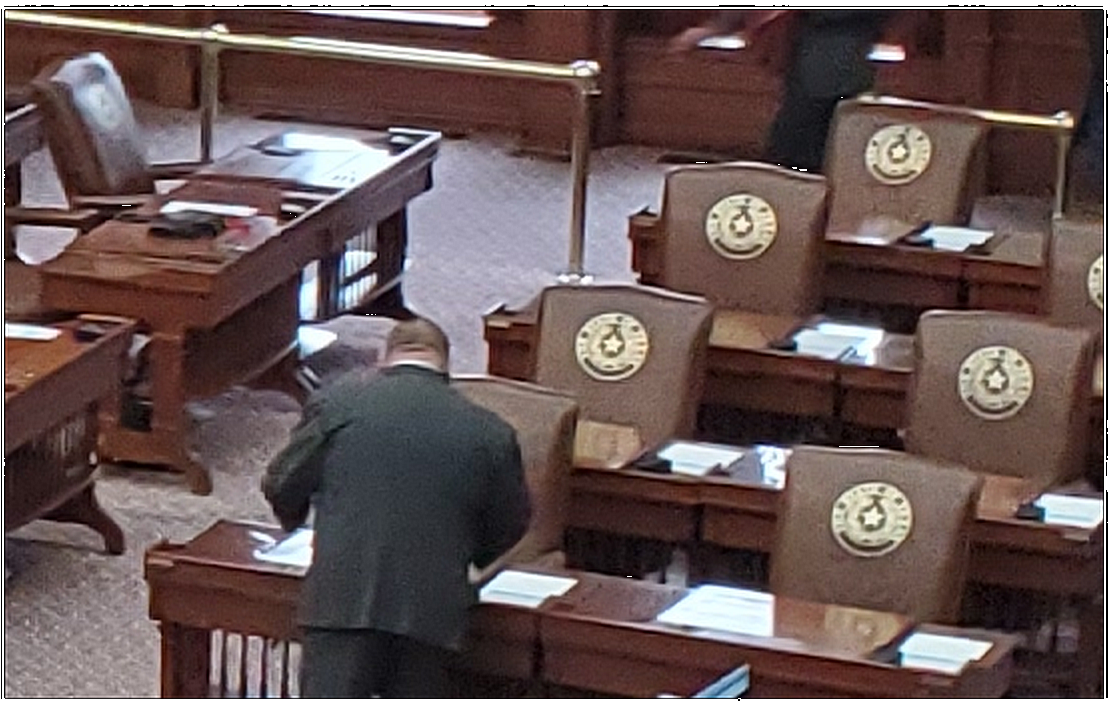 You may have seen that. Just like y’all, these people ran for office and that means doing the job. When the Governor leaves Texas, Dan Patrick assumes that position. If Trump were in the hospital, JD Vance would assume that position. When these people leave the state ON PURPOSE TO THWART THE BUSINESS OF THE STATE, there isn’t anyone to assume their positions, so they should be declared VACANT.
 The key here is intent. They didn’t leave to attend a relative’s funeral or wedding. They didn’t leave because they are reservists and were called up to active duty. They didn’t leave during a called session for a vacation. They left to prohibit the Texas House from doing its work, the work of the people.