Two years ago, I wrote a column on candidates citing their endorsements.
This year, let’s discuss the entities who make endorsements. What’s the value of those? Well, it depends.
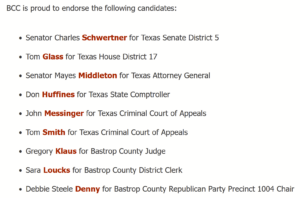
We’re going to use the email sent out from Bastrop County Conservatives with their list of endorsements as an example. The BCC website states:
Process
A BCC committee sources, identifies and meets with potential candidates for office and meets with declared candidates in order to consider them for support and endorsement by BCC. Our Leadership Team then votes to determine which candidates BCC will endorse.
Did the organization interview all “declared candidates” for an office?
BCC did not interview all “declared candidates”. If the organization didn’t interview all candidates for an office, they can’t possibly know which candidate most closely aligns with their values.
If they did not interview all “declared candidates”, did they indicate that they did not?
BCC did not indicate that they failed to interview all “declared candidates”. A simple statement under the endorsement like “We did not (or ‘We were unable to’) interview candidate A or candidate B” helps lend credibility to the endorsement.
Candidates for Texas Attorney General, Texas Court of Criminal Appeals, Bastrop County Judge, Bastrop County Precinct Chair 1004 (and possibly other races) were not interviewed or even contacted.
The list below doesn’t say that so how would voters know?
Did the organization send a questionnaire to all candidates?
BCC did not send a questionnaire. Another PAC invites all candidates for an interview. If a candidate doesn’t respond, oh well. The candidate had a chance and didn’t take it. If the candidate is non-responsive, they can’t expect an endorsement. That’s fair. Just ignoring candidates for an office, then endorsing some alleged favorite, is of no value to voters.
If they did not send a questionnaire to all “declared candidates”, did they state that they did not?
There is no statement indicating whether all candidates were interviewed or sent a questionnaire. The “process” BCC describes on their website leads the voter to believe that all “declared candidates” were interviewed. But they were not.
Did the organization provide an explanation for their choices?
BCC provides no explanation of how it decided who to endorse. There is not one sentence that explains what about a particular candidate caused them to endorse that candidate.
What good, then, are these endorsements?
None. Personally, I think voters need to know why a candidate was chosen for endorsement, what makes that person more fit for the job than any of the other candidates.
BCC (and any other PAC that provides a list without explanation) thinks GOP voters are lemmings and should just vote for whomever BCC endorses.
The conclusion of my April 22, 2024 blog post bears repeating:
Never be a lemming. Just because this group or that says “vote for our list of candidates” or worse yet, “take our list to the polls with you”, that’s not what you should do in a primary, runoff, or uniform (May non-partisan) election.
Expect information. Better yet, demand information or refuse to be a lemming. Your vote is yours, not theirs.
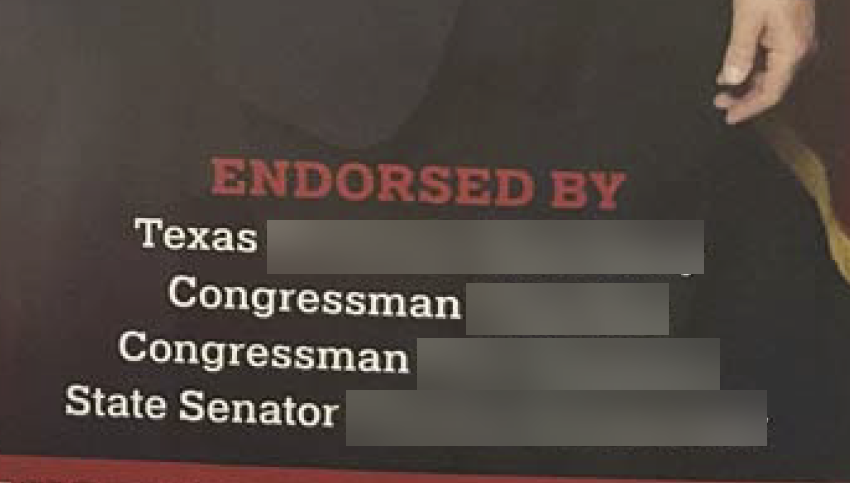 Don’t be awed by endorsements. Rather, ask yourself, “If that endorser opposed a measure I support, who’s opinion would the candidate (now officeholder) weigh more heavily?” When it comes to a vote and the chips are down, if donations are involved, the endorser wins, the voters lose. It’s rarely the other way around.