Election Integrity: Highest Priority

For many elections, I have served as presiding judge of the Early Voting Ballot Board, Signature Verification Committee and Central Count. This position is critical to the validity of our elections. (These committees are described below.)

I filed to run for Republican Precinct Chair in my precinct, 1008. A few weeks later, so did someone else. That made it a contested race. Contested candidates cannot serve as the presiding judge of these committees. So, I had a choice: continue to serve as presiding judge or run for precinct chair.

I chose election integrity and serving as presiding judge.

Below is the letter I sent to Justin Bezner, Bastrop County GOP Chair. I have withdrawn my name from the ballot. As I said in my letter, there are many ways to serve the Republican Party. I’ll continue my involvement through the Lost Pines Republican Women, the Bastrop County GOP Club, and when called upon, through the BCRP.

Powered By EmbedPress

What’s the “Early Voting Ballot Board” and “Signature Verification Committee”? What’s “Central Count”?

These are two groups, made up of an equal number of Republicans and Democrats, that are critical to ensuring election integrity.

Early Voting Ballot Board
An early voting ballot board (EVBB) shall be created in each election to process early voting results from the territory served by the early voting clerk. No matter what type of election an entity is having, they must have an early voting ballot board.

In Bastrop County, the EVBB also typically serves as the Signature Verification Committee, ensuring that a ballot signature matches the application. This is a critical function for election integrity.

Central Counting Station
A central counting station (“CCS”) is the place on election night where ballots are counted, vote totals are accumulated, precinct returns are completed and the unofficial elections results are generated.

Follow the Money

Candidates are legally required to file financial disclosure forms. Why? Primarily so you know where a candidate is getting their money.

May 3 contested candidates were required to file 30-day and 8-day prior reports by April 3 and April 25 respectively. Let’s take a look at who filed or failed to file and what the reports tell us.

If you’ve not spent a lot of time looking at these reports or reading on Texas Ethics what candidates must report, they may be confusing. So, I’ll break them down with what I see that should concern City of Bastrop voters: who is getting money from developers.

First, it’s the law that candidates with opponents file reports on time (Sec. 254.037. FILING DEADLINE). While local election reports aren’t filed with Texas Ethics, Texas Ethics rules apply to all filings. Texas Ethics provides a synopsis of what local candidates must file and when. Even after an election, win or lose, candidates with money in their accounts must file reports by Jan 15 and July 15 annually.

Let’s look at issues revealed by these reports.

city council place 5

city council place 1

  • Perry Lowe’s donations of note: Robert Trevino (City Manager’s husband $65); Joe Grady Tuck ($250); Home Builders Assoc-HOMEPAC ($250); Texas Realtor’s PAC-TREPAC ($2,000 pledged)
  • Cecilia Serna: Serna chose modified reporting, meaning she would not raise or expend over $1100.

mayoral candidates

  • Ward Northcutt identified all donors and expenses properly in both his 30-day and 8-day reports.

april 30 updates

  • Perry Lowe missing donation: According to their 8-day prior Texas Ethics filing, Mel Cooper’s BCC GPAC donated $500 to Perry Lowe’s campaign. It does not show in Lowe’s 30-day prior or 8-day prior campaign finance reports.
  • Cecilia Serna 8-day report: Once a candidate exceeds the $1100 of modified reporting, that candidate is required to file reports. Cecilia Serna filed an 8-day prior report on time after having exceeded the $1100 modified reporting limit.

summary

Question Mark ManAsk yourself how a candidate will manage taxpayer money if they can’t properly manage campaign funding. Ask yourself who will get their ear and vote if they’ve taken money from developers and development-related PACs (Political Action Committees).

Candidates John Kirkland and Perry Lowe have taken significant funds from the development community. Willie DeLaRosa hasn’t filed the legally required reports. Ishmael Harris hasn’t reported all his campaign income and expenses as legally required.

The only candidates to properly fill out these reports were Ward Northcutt who is running for mayor and Cecilia Serna running for City Council, Place 1. Cheryl Lee had a minor error in one report, but shows no donations from developers.

These public documents are for your benefit. They are required so you know where a candidate is getting their money and how they are spending it. Know before you go.

1 https://www.cityofbastrop.org/upload/page/0601/Election_2025/John%20Kirkland/Kirkland_30th%20Day%20Finance_Redacted.pdf
2 https://www.cityofbastrop.org/page/cs.candidate_officeholder_documents
3 https://www.cityofbastrop.org/page/cs.election_may2025_SPECIAL
4 https://www.ethics.state.tx.us/data/resources/guides/Gpolfund.pdf
5 https://www.ethics.state.tx.us/data/resources/guides/Gpolfund.pdf

Thin Skinned

Politics is not for the faint-of-heart. Anyone who has run for office, or served in office, knows that. We’re all very opinionated and most of us, passionately so. Those who don’t agree with their representatives often come out with guns blazing (not literally, just verbally). It’s just the way it is. The elected official can engage in the gun-fire with nasty retorts, or step back and invite discussion. What the elected official cannot be is thin-skinned and defensive.

Sadly, our current House member, Stan Gerdes, has demonstrated that he is both thin-skinned and defensive. In 2022, he was asked at multiple GOP meetings whether he supported Dems as committee chairs in the Texas House. Notwithstanding Republicans being strongly in the majority, he supported Dem chairs (video at 6:13). Those of us who worked hard to get Republicans elected felt betrayed. And, we told him so.

In 2024, we’ve again said “No Dem Chairs” and once again, he is supporting a House Speaker who lost the Republican Caucus vote and who will appoint Dem chairs.

Republican committee chairs are critical to passing TexasGOP legislative priority bills. This is important enough that the TexasGOP sent a mailer to Bastrop County Republicans asking them to call Gerdes’ office and “tell him to oppose Dustin Burrows and support the Texas House GOP Caucus Nominee David Cook!”

Then, the Bastrop County GOP passed a resolution calling “on Representative Stan Gerdes to publicly commit to supporting the Texas House Republican Caucus nominee in accordance with the Caucus vote and with the Republican Party of Texas Platform”. Seems reasonable.

That resolution also explained that:

  • “A vote against the Texas House Republican Caucus nominee shall be considered a censurable act”; and
  • “subversive tactics such as denying a quorum or participating (sic) in absenteeism that causes a quorum to come into question […] shall be considered a censurable act”; and
  • “a vote for a House Speaker secret floor ballot vote, will be interpreted as an attempt to hide a vote with Democrats who want Democrat Chairs […] and shall be considered a censurable act”; and
  • “a vote […] for any other candidate who has not pledged publicly, prior to the floor vote, to comply with the Legislative Priorities of “No Democrat Chairs” shall constitute a censurable act.”

Stan Gerdes was not censured. The elected Republican precinct chairs simply expressed their opinions and what they expected from their Republican House member.

Precinct chairs are elected to be the voice of the Republican Party. Gerdes was elected to represent House District 17. These are very different constituencies.

Gerdes can stick to his position supporting Democrat chairs and do what he believes is in the best interest of his constituents. But, as with every decision an elected official makes, there are consequences to those decisions. And, the Bastrop County Republican Party has made clear what those consequences will be. Seems reasonable.

Rather than throw verbal bombs on Facebook at Republican Party leadership, a mature, seasoned elected official would either invite precinct chairs to a meeting or personally call each one, building bridges. He would not whine because he wasn’t invited to the meeting where the resolution was passed. He would not call candidates who ran against him three years ago “vengeful”. He wouldn’t worry about a candidate that spent under $20,000 in a campaign cycle when he, himself, spent over half a million. He would not call the Republican Chair a liar. He would not send threatening texts. He would not make unfounded accusations and name-call publicly on social media.

I sure as heck hope this isn’t the way he treats his fellow legislators when they disagree with him. And, if, as I hear repeatedly, Stan Gerdes wants to run for Congress or some other higher office, he needs to get thicker skin. He needs to immediately start building bridges not burning them down.

VOTE

Texas offers a lot of opportunities to vote. We have early voting for 2 weeks. Of course, we have election day voting. We have mail-in voting for those over 65 and out of county or state during the election season. We have overseas voting for both military and ex-pats. And, for those who cannot get into the polling place safely, we have curbside voting.

There are no excuses for not voting.

It’s a simple thing to do: express your opinion. Most of us do that at every opportunity. So why don’t people vote? Some think it doesn’t matter, but we’ve seen slim margins in so many races lately, it’s hard to believe people still think their vote doesn’t count.

I think that it’s just that people get busy with their every day lives and forget. I heard just a few days ago that 20% of those who say they’re going to vote on Election Day itself, don’t vote.

So, I got a voter registration list for my precinct. I sorted it by those who voted in the 2020 or 2024 GOP primary. Here in Texas, the list of daily voters is published on the Secretary of State’s website. So, I printed the primary voter list and, if they voted already, I crossed them off the list.

I sent a post card to each voter reminding them to early vote.

Results? Just shy of 50% of those people voted in the next 3 days.

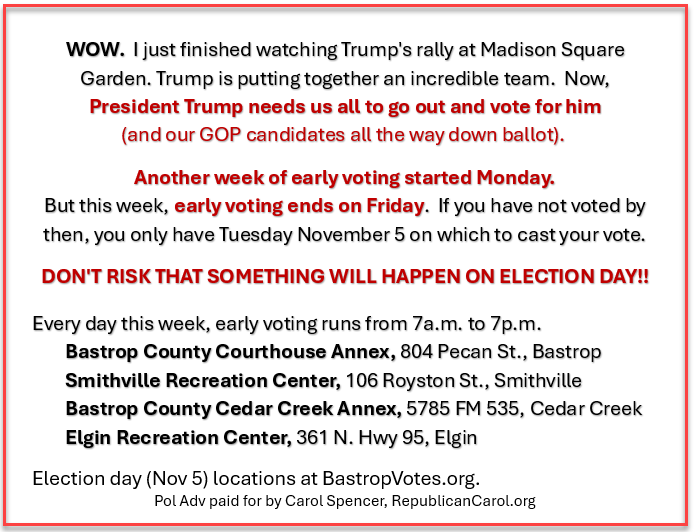
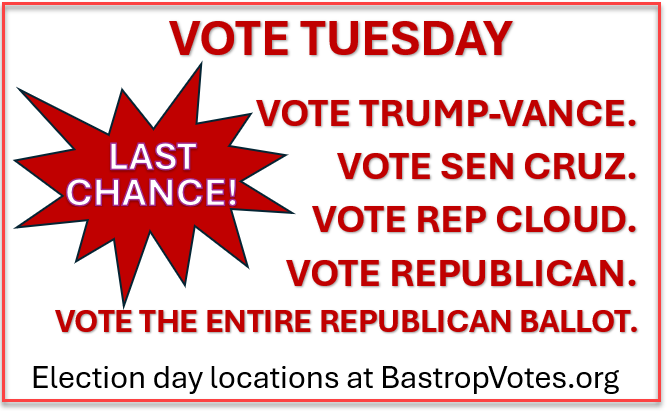
Today, those who still haven’t voted are getting another card to remind them that Tuesday is their last chance.

Let’s hope this works to get out the vote. The future of our country is determined by those who vote. If you stay home because politics isn’t your “thing” or you’re disgusted with the tone of discourse, you have no right to complain if things don’t go the way you had hoped. VOTE!

Arrogance is Divisive and Damaging

What’s with political organizations that refuse to work with other political organizations? I’ve been involved in the political world since 1987, 37 years. I’ve been president of multiple organizations. I’ve been an elected official. I’ve been an elected Party official in 2 states.

I’ve never seen so many ego driven, divisive, arrogant, political leaders in all those years as I see today. I’ve never seen so-called “leaders” who flat out refuse to talk to or work with other Party organizations, who publicly denigrate elected officials. Even for defeated candidates, it’s important not to “burn bridges”, but “burning bridges” seems to be the norm now.

We must work together. We must talk with each other. We must respect each other’s organizations and how they operate. We must acknowledge our differences and strive to find common goals. We are stronger together.

lots of people graphic

One would think that as conservatives, we would do that. But what happens when the arrogance of certain leaders just flat out refuses to do so? Apparently, they don’t realize they are hurting themselves, their organizations, and our GOP candidates.

Put your egos aside people. If you can’t, you don’t belong in leadership of any kind, especially in the political world.

Remember “United We Stand. Divided We Fall.”

Read Between the Lines

People collect things. I collect campaign literature. I have campaign literature going back probably 30 years. Some is good; some is awful; some is clever; some really, really boring. Some has colors that are just atrocious. Some was done with nary a thought for the low-vision user. Some is just evidence the candidate doesn’t know what they’re doing, or worse, why they’re running.

Campaign literature is sales literature. The candidate is selling you on why they’d be the best in the position. Here are my four rules when it’s campaign time: Don’t be fooled or swayed by photographs in the mailers; Know what the candidate can and cannot do in office; Read carefully; Find and research the legally required “paid for by”.

Rule #1: Don’t be fooled or swayed by photographs in the mailers.

Some candidates use photos of themselves with their families or children. Why? To tug at your heart strings… “Oh isn’t that cute!” Cute isn’t what you need from an elected official. Candidates need conviction and back-bone. They need to be strong, not sway the way the wind blows. They don’t need to be cute.
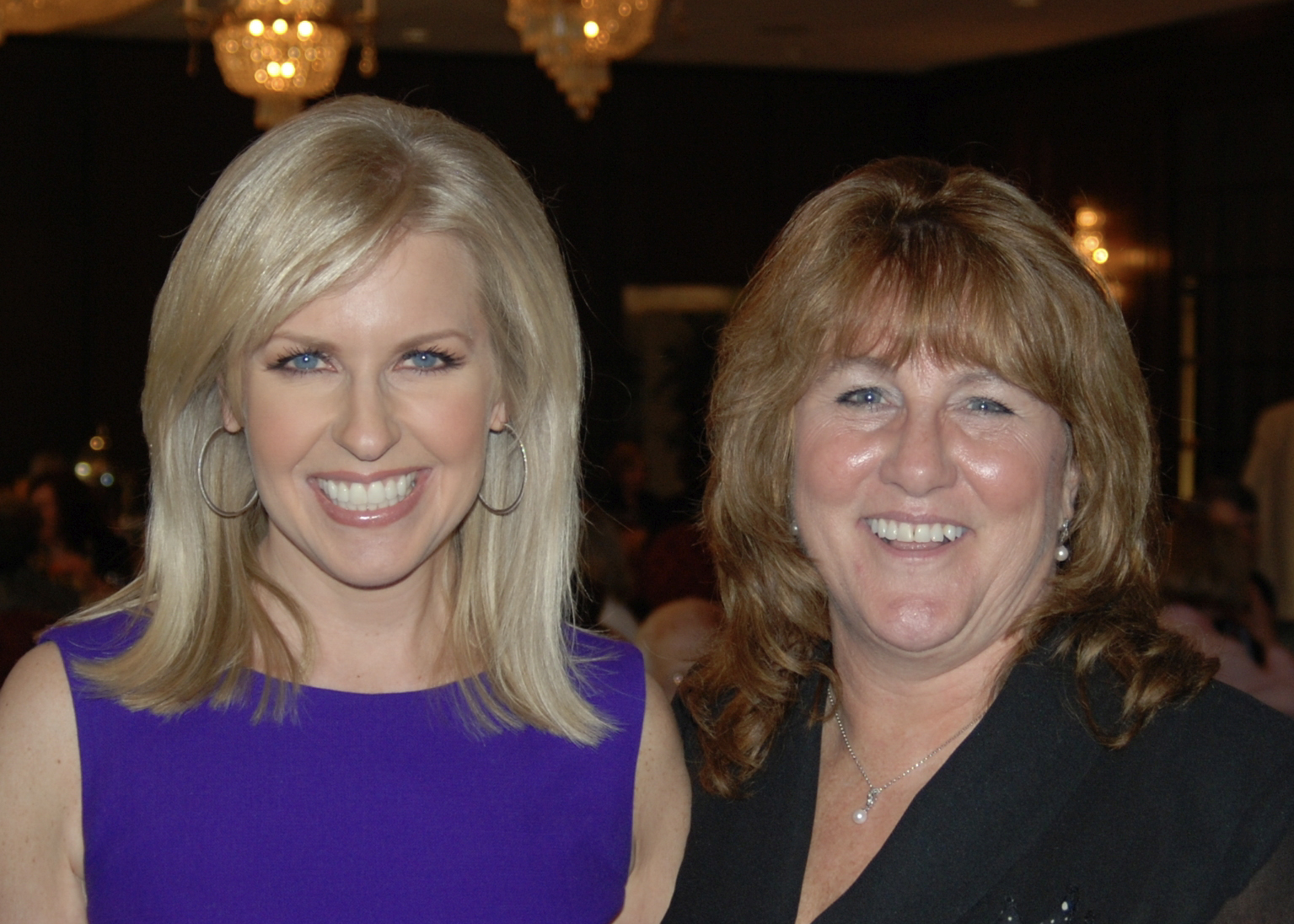
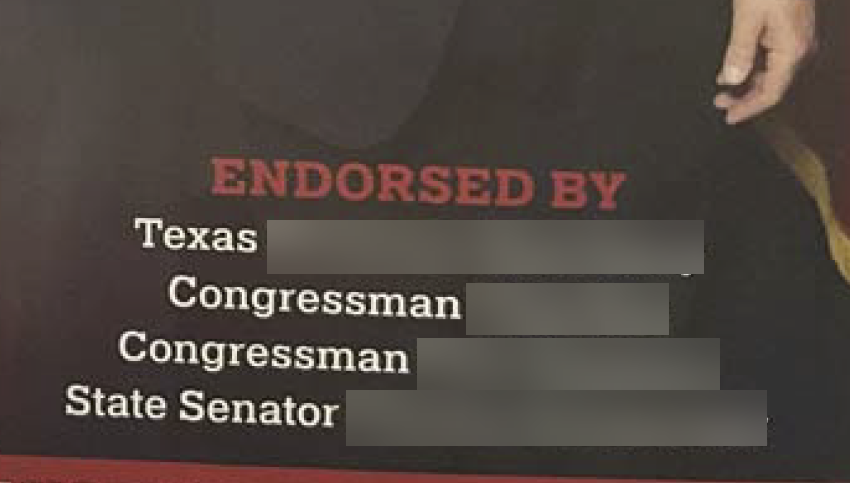
Carol Spencer with Monica CrowleyWhy do some of them use photos with famous elected officials? To make you think that person supports their candidacy. But do they? This is Monica Crowley and me a few years ago at a GOP event. Having a photo with her didn’t mean she endorsed my candidacy. The same is true of photos with Kellyanne Conway, Rudy Guiliani, Sarah Palin, Ken Paxton, Sid Miller, Governor Abbott and so many others with whom I’ve been photographed over the years. Photos with famous politicos, unless accompanied by the words “Endorsed by [name of person in photo]”, should be interpreted as manipulative, meant to make the candidate look important or to make the reader think that person has endorsed the candidate.
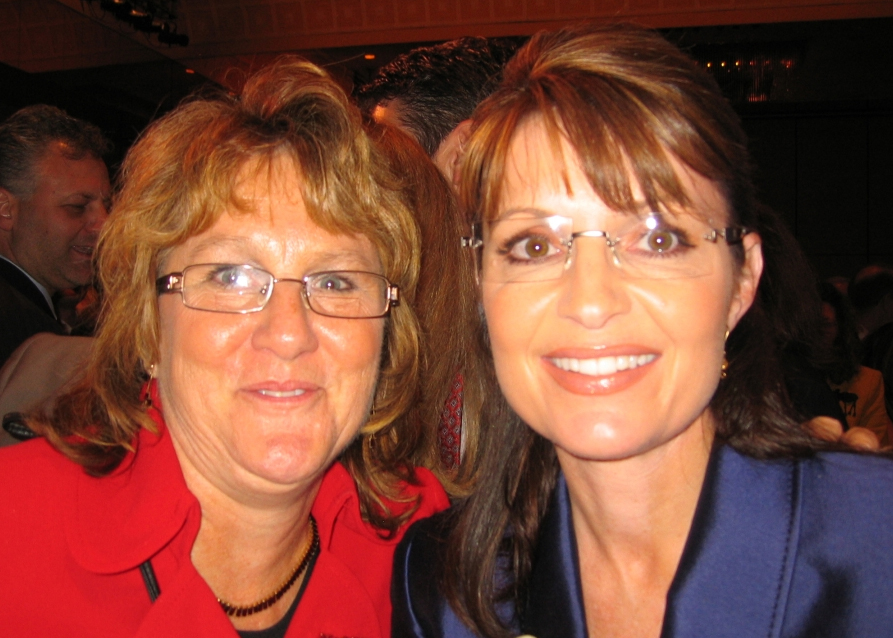
A list of endorsements by others, but not the person in the photo, when used together is pure deception. Back to top

Rule #2: Know what the candidate can and cannot do in office.

Someone running for a legislative position cannot do anything without a majority vote of the body in which they serve (city council, TX House, TX Senate, US House, US Senate). They cannot fix the border or cut government spending. And usually, the executive (mayor, governor, president) has to sign any passed legislation to make it law.

Someone running for an executive position can only do that which the charter or constitution allows. And, a great deal of what is allowed requires a vote of the legislative body: budgets, capital spending for example.

This is called “checks and balances”.

When an incumbent running for re-election says they accomplished this or that, no they didn’t. They cast one vote for legislation to make that happen. Perhaps they swayed colleagues to do the same. But in the end, without a majority vote and a supportive executive, nothing they support will ever come to pass.

And, remember what position they’re running for… a mayor cannot close the border, fund medicare or fix social security issues. A congressman can’t get local roads paved. Back to top

Rule #3: Read carefully

Beware the use of “conservative”. Does a true conservative support Democrat chairs in the legislature? Does a true conservative celebrate being endorsed by staunch Democrats? Does a conservative group endorse candidates who previously voted Democrat?

There’s a big difference between “voted to close the border” and “closed the border” but you’ll see both on campaign literature.

“Most experienced” is something else you’ll often see. If you don’t know what the requirements of the position include, how will you evaluate “most experienced”? If the person has always been a chief executive, but is running for a legislative position, that person probably does not have the requisite experience. A chief executive calls the shots. A legislator must count votes for bill passage and must sway a majority to his/her line of thinking. These are very different skill sets. Back to top

Rule #4: Find and research the legally required “paid for by”

All campaign advertisements must include who paid for them. This is critical to know. Did the candidate (well, actually, the candidate’s donors) pay for the mailer? Did some PAC (political action committee) pay for it?

If a PAC paid for it, ask yourself what that PAC expects to get for the expenditure of funds. Mailers are very expensive: design, printing, mailing costs. A county-wide GOP mailer can easily cost $5,000.

Do an online search for the PAC itself and see what it’s about. Go to OpenSecrets.org for Federal PACs and see who else got money from that PAC. Go to Texas Ethics Commission (TEC) for State PACs.

This is also true of the various emails requesting money. Where’s it going? Watch carefully. Sometimes something will appear to be for a candidate, but the money you donate is going elsewhere. Be careful! Back to top

The Value (or not) of Endorsements

Candidates love to share their endorsements. Why? They believe you’ll find a name among that list that you admire, and thus will vote for that candidate.

But should you? My husband, who has also been involved in the political world for many, many years, says “Endorsements are only good on the back of a check.” I agree.

What difference does it make if a beloved former (or current) governor or legislator, or well-known local, endorses a current candidate? That “former (or current)” or “well-known” won’t be serving in office. They don’t vote. The candidate, once an officerholder, does.

Will that former or current elected official, or well-known local, have significant influence over the actions and votes of the candidate? Will that endorser’s influence exceed that of the voters? Yes, it will. And, if campaign contributions flow from that endorser, my “yes” is iron-clad.

Endorsements ListDon’t be awed by endorsements. Rather, ask yourself, “If that endorser opposed a measure I support, who’s opinion would the candidate (now officeholder) weigh more heavily?” When it comes to a vote and the chips are down, if donations are involved, the endorser wins, the voters lose. It’s rarely the other way around.

The TX House vote to impeach Ken Paxton is but one example. All but 5 Republicans who took money from Dade Phelan voted to impeach: 49 of them. Did that accurately reflect the wishes of their constituents? Not likely.

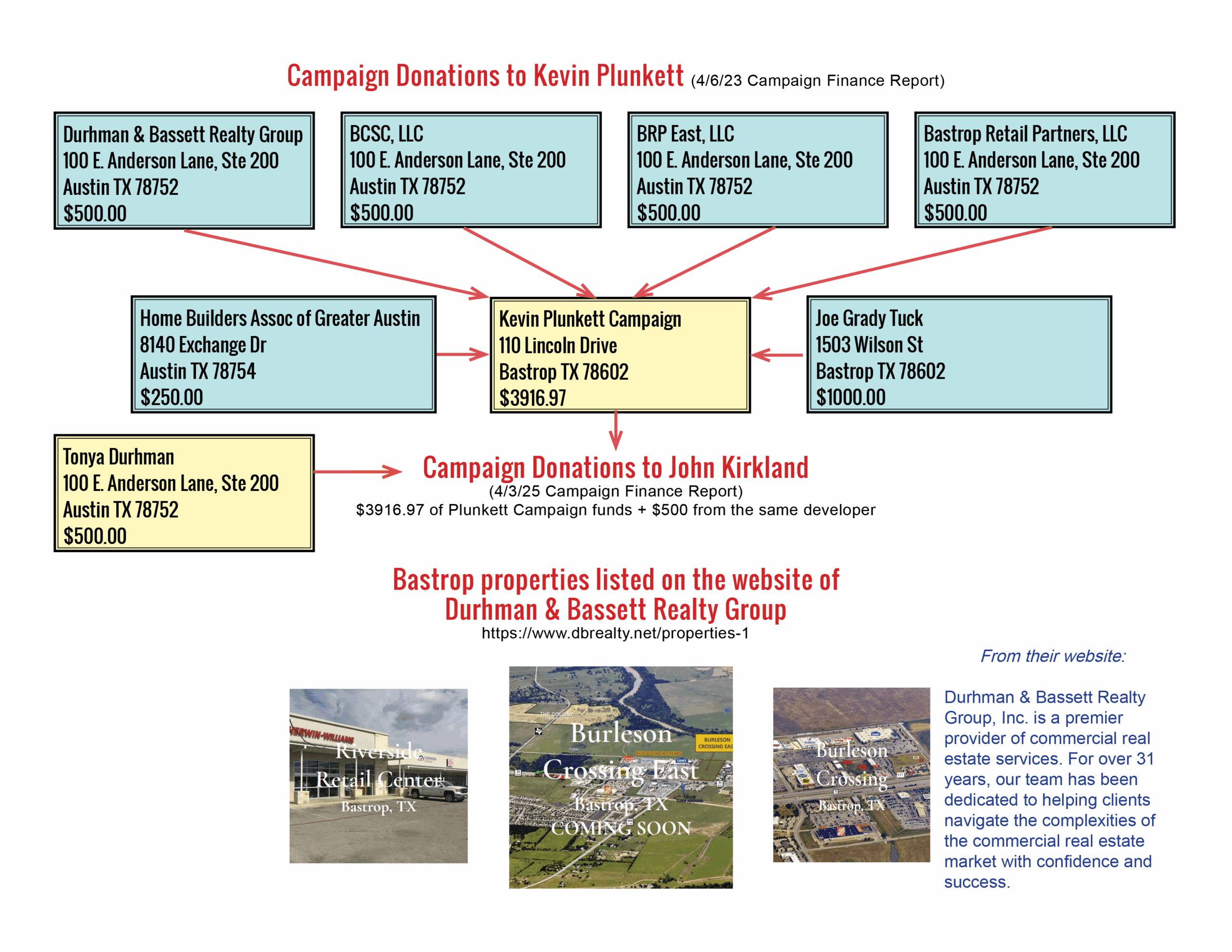
Another example: Let’s say managing excessive growth is your highest priority (as it is for many in Bastrop County). Along comes a candidate’s literature stating that they are endorsed by major residential and commercial developers or a law firm that makes a good deal of its money from representing developers or a real estate PAC or an entity with which they have a business relationship.

Once in office, will that candidate vote with the wishes of his/her constituents or the endorser? What if that endorser helped fund the campaign? You know the answer.

The only caveat in this is if you research the endorser’s background or votes during his/her term of office and find you’re majorly in agreement with the endorser’s stands on current issues. But you must do that research specifically regarding current issues. I repeat: current issues. A good example of this is a Trump endorsement.

It means nothing if you agreed with that endorser’s stand on the war in Iraq, but disagree with his/her current stand on school choice, casino gambling, water, immigration or any other issue facing the county or state.

And remember, current elected officials who endorse often have their own agendas: which candidate can or will help me the most when I run for re-election or which candidate is likely to win, making me look like a winner?

The only endorsement worth anything is that of the voters, your endorsement. You have the power. Don’t be swayed by a list of allegedly important names.