WARNING: Long, but really important post
Tax abatements shift the tax burden from the business getting the abatement to all other taxpayers. How does that happen?
It’s a simple concept. Governments budget income and expenses, just like you do. Local government income is primarily tax revenue. Expenses? I don’t think I need to explain those…. government spending.
Let’s talk about taxes (income). There are property taxes, sales taxes, hotel occupancy taxes, personal property taxes on businesses and some others. But that will do for my example.
Let’s say Local Government A gets revenue as follows:
Residential property taxes: $1,000,000
Commercial property taxes: $2,000,000
Hotel & Occupancy taxes: $ 500,000
Personal Property taxes: $ 750,000
TOTAL INCOME: $4,250,000
BUDGETED EXPENSES: $4,250,000
BUT, local elected officials decide that Business A should get a “tax abatement” and not pay any (or reduced) commercial property taxes or personal property taxes for the next 5 years.
In our example, we’ll say that Business A is estimated to pay $50,000 in commercial property taxes and $25,000 in personal property taxes each year. Also, the county has agreed to handle all administrative tasks (expense), do road repairs (expense), waive inspection fees (expenses incurred but not reimbursed by fees). Let’s estimate that to be $75,000 in expenses and lost income.
So now, with abatements, TOTAL INCOME above becomes $4,175,000 ($4,250,000 minus $75,000). Then there are those incurred expenses not paid by Business A, but paid by the local government. So, BUDGETED EXPENSES is now $4,325,000 ($4,250,000 + $75,000).
A net zero budget is now $150,000 in the hole and someone, some taxpayer, has to make up that deficit.
Every time there is an abatement without a matching reduction in spending, some other taxpayer picks up the tab.
Abatements give businesses tax breaks. There’s no such thing for residential property owners. We residential property taxpayers just pick up that deficit created by the abatements because there’s never a reduction in spending.
In fact, development increases government costs to provide services. Industrial/commercial less than residential, but all development increases costs. And, the “Order” on Tuesday’s agenda specifically states such as follows:
The County recognizes that participation in the Texas Enterprise Zone Program may require ongoing administrative coordination, reporting, record retention, compliance monitoring, and financial review by County staff, including the County Auditor’s Office and other County departments. The Commissioners Court reserves the right to establish administrative procedures, cost recovery mechanisms, or related agreements, as authorized by law, to support the administration of enterprise projects.
I’ve never seen a study in Bastrop County about the per capita cost of services. I’ve never seen a study here proving the income generated by a business exceeds the increased cost of government services. All we ever hear is how much revenue a development will generate. It sounds good, but my experience in local government elected office says it rarely works that way. And, even when it does, shouldn’t someone give taxpayers a true financial analysis?
The Bastrop County Commissioners, all Republicans, have Order 2026-09 on their agenda the day after Memorial Day at 9 a.m. Great timing with schools out and a preceding holiday weekend. Even poorer timing considering it’s election day.
Any patriot working the election will be unable to attend the meeting either in person or online to express their opinion about this issue. To me, someone who has worked elections for years, this is a real slap. (Full disclosure, I’m not working this election due to a prior out-of-state commitment.)
The order seeks to “ordain” the County’s participation in the Texas Enterprise Zone Program. According to the Governor’s website, “The Texas Enterprise Zone Program (EZP) is a state sales and use tax refund program designed to encourage private investment and job creation in economically distressed areas of the state.” (emphasis added)
I stress “economically distressed areas” in the above description. There’s a map on the Governor’s site. Space X is not in an “economically distressed” area. Nor is Bastrop County designated as a “distressed county”. The County admits so in its “Order“.
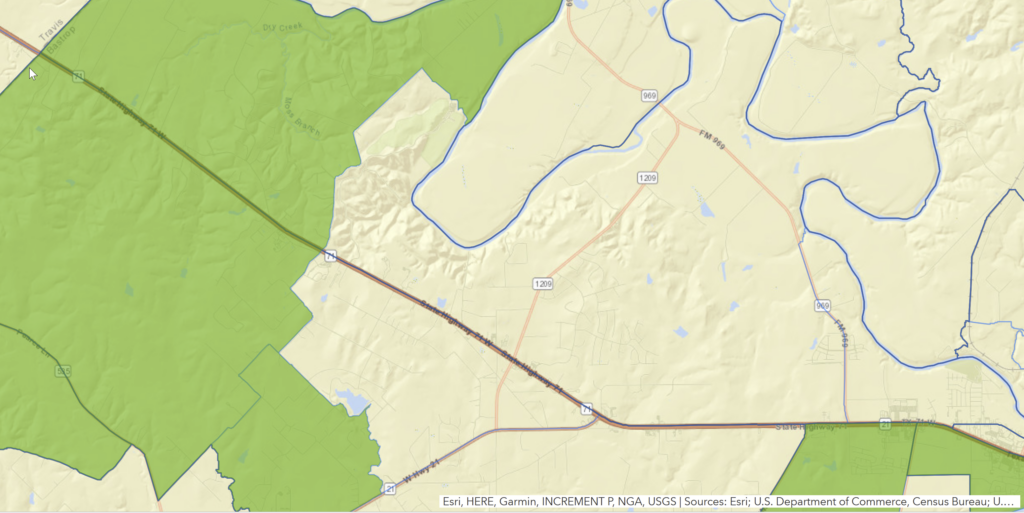
Every application of the Texas Enterprise Zone Program to a business that is not in an economically distressed area denies those benefits to a business or county that is in such an area. Eligibility is limited according to the Governor’s website.
“…communities with a population of less than 250,000 have 6 designations available. The state may award a maximum of 105 designations statewide per biennium, and may award up to 12 designations per quarterly round.”
Then there’s the fact that this is an all-Republican Commissioner’s Court. We didn’t elect these people to give tax breaks to businesses while residential property taxpayers get slammed. The GOP Platform gives guidance on this.
No Corporate Welfare: We encourage government to divest its ownership of all businesses that should be run in the private sector. We oppose all bailouts of and subsidies to domestic and foreign government entities, states, and for all businesses, public and private. We agree with the Texas Constitution’s requirement for fair and uniform taxation andoppose special treatment or tax breaks for favored industries or companies. We call for repeal or sunset of existing subsidy or special-interest tax exemptions, including the Special Events Trust Fund program, the Texas Enterprise Fund, Moving Image Industry Incentive Program, and lab-grown meat incentives, and now request repeal of Chapter 403.601 of the Texas Tax Code. […] (Plank 78, 2024 Texas GOP Platform, highlighting added)
So, why are they doing this? Star-struck perhaps? Because it’s Elon Musk? Perhaps it’s pressure from higher levels of government. Frankly, that would be my guess.
In conclusion, I don’t care what business owner is getting a tax break. I don’t believe in them. Redirecting the tax burden from one entity to another is socialist thinking.
I’m actually an Elon Musk fan. I don’t blame him for trying to get every break he can for his businesses. But our elected officials were put there by US, by the voters. Elon Musk, Governor Abbott, Donald Trump did not put them at the dais. We did. And they need to remember that, remember who they are supposed to represent, when voting to give another business a tax abatement.