Tax Abatements: Not an All-or-Nothing Levy

There are several problems with tax abatements. First, many elected officials aren’t really saavy about taxation impacts. Second, flat rate abatements put more money in the pockets of businesses no matter how successful they are. Third, it only takes a little logic to realize that if government doesn’t lower spending commensurate with the money they aren’t collecting, someone (read all other taxpayers) picks up the tab.

Taxation Impacts

I’ve written before about elected officials strutting around telling citizens how much revenue some development will generate. I’ve complained that these same elected officials never provide an estimate of the government services costs associated with that same development. Do we taxpayers ever get to see an income to expense report? Ask for one and you’ll get your answer.

I did one in Denville Township when I was in office. It wasn’t hard to calculate the cost of municipal services per capita. That included municipal expenditures and school expenses (Denville has 2 school systems: K-8 and a regional high school system). Using census data, it wasn’t hard to figure these numbers. It also wasn’t hard to find the total annual tax revenue. It was a line item in our budget, as was the annual collection rate (not everyone pays their taxes on time).

We also used a term which I’ve never heard in Texas: ratable. A “ratable” was a development that generated more in taxes than it cost in services. Isn’t that what they should be seeking? If they have no idea what a development will cost (police, fire, public works, administration, etc), how can they begin to think that just because it generates revenue, it’s a good thing for the government (taxpayers) bottom line?

Most of us balance budgets ourselves comparing income to expenses. It’s time governments be required to do so for every new development of a certain size. Without that, they can’t justify one dollar in abatement.

The Abatement Drain

Let’s use the abatement Bastrop County gave to the EdgeConneX data center as an example. It abates 75% of property taxes for 10 years. Why?

Data centers are basically racks and racks of computers. Is the EdgeConneX a carrier neutral data center (meaning multiple customers use the data center)? Or will it be a single customer data center (for example, serving only one business)?

In either case, why a 75% property tax abatement if the data center is, for example, 50% full? That makes no sense.

What does make sense is an abatement based on occupancy as a proxy for income. If a carrier neutral data center is only 20% full year one, then a 75% abatement makes sense that year. If that carrier neutral data center is 50% full in year two, then a 50% abatement makes sense that year. And, on and on. Consider this possibility:

0 to 20% rack occupancy: 75% abatement
21% to 40% rack occupancy: 60% abatement
41% to 60% rack occupancy: 40% abatement
60% to 80% rack occupancy: 20% abatement
Over 80% rack occupancy: no abatement

This makes far more sense than a flat 75% for 10 years. If only one customer is leasing data center rack space, the abatement could be 75%, 50%, 25%, 0%, dependent on functional rack space.

Lower Government Spending

A data center will require enhanced and potentially specialized public services like police and fire. Specialized equipment, chemicals, lighting, electrical connections, specialized fire fighting apparatus and more will be required.

Who will pay? Texas doesn’t have an off-site improvement law requiring developers to pay for off-site improvements needed as a result of their development. There is no law requiring impact fees. Impact fees cover things like additional schools or classrooms required as a result of housing developments.

Even if it did, because counties have no land use regulatory authority, it is likely that developments in unincorporated areas wouldn’t garner the benefits of either of these.

Again, who will pay? Logic says it should be the developer by paying the full freight of their property tax levy. But a 10-year abatement changes all that. Some improvements, like power infrastructure, water and sewer lines, need to be built within that 10-year abatement, which means other taxpayers (residential, commercial & industrial) will pay higher bills to cover those costs. A good example is the million dollar right turn lane paid by City of Bastrop taxpayers instead of the developer who caused it to be needed in the first place.

Solution

I submit that our elected officials stop giving away flat rate abatements. Personally, I’d like to see them stop all abatements. But, if they must because that’s the only way they can put some controls on a development as the county commissioners claim, they should tie an abatement to business success.

If a business makes more money, the tax abatement is reduced accordingly. Data centers fit this model perfectly and our county commissioners should start using common sense. Stop saddling current property taxpayers with a bill the business should be paying.
Enterprise Zone Tax Breaks? NO!

WARNING: Long, but really important post

Tax abatements shift the tax burden from the business getting the abatement to all other taxpayers. How does that happen?

It’s a simple concept. Governments budget income and expenses, just like you do. Local government income is primarily tax revenue. Expenses? I don’t think I need to explain those…. government spending.

Let’s talk about taxes (income). There are property taxes, sales taxes, hotel occupancy taxes, personal property taxes on businesses and some others. But that will do for my example.

Let’s say Local Government A gets revenue as follows:

Residential property taxes: $1,000,000
Commercial property taxes: $2,000,000
Hotel & Occupancy taxes: $ 500,000
Personal Property taxes: $ 750,000
TOTAL INCOME: $4,250,000
BUDGETED EXPENSES: $4,250,000

BUT, local elected officials decide that Business A should get a “tax abatement” and not pay any (or reduced) commercial property taxes or personal property taxes for the next 5 years.

In our example, we’ll say that Business A is estimated to pay $50,000 in commercial property taxes and $25,000 in personal property taxes each year. Also, the county has agreed to handle all administrative tasks (expense), do road repairs (expense), waive inspection fees (expenses incurred but not reimbursed by fees). Let’s estimate that to be $75,000 in expenses and lost income.

So now, with abatements, TOTAL INCOME above becomes $4,175,000 ($4,250,000 minus $75,000). Then there are those incurred expenses not paid by Business A, but paid by the local government. So, BUDGETED EXPENSES is now $4,325,000 ($4,250,000 + $75,000).

A net zero budget is now $150,000 in the hole and someone, some taxpayer, has to make up that deficit.

Every time there is an abatement without a matching reduction in spending, some other taxpayer picks up the tab.

Abatements give businesses tax breaks. There’s no such thing for residential property owners. We residential property taxpayers just pick up that deficit created by the abatements because there’s never a reduction in spending.

In fact, development increases government costs to provide services. Industrial/commercial less than residential, but all development increases costs. And, the “Order” on Tuesday’s agenda specifically states such as follows:

I’ve never seen a study in Bastrop County about the per capita cost of services. I’ve never seen a study here proving the income generated by a business exceeds the increased cost of government services. All we ever hear is how much revenue a development will generate. It sounds good, but my experience in local government elected office says it rarely works that way. And, even when it does, shouldn’t someone give taxpayers a true financial analysis?

The Bastrop County Commissioners, all Republicans, have Order 2026-09 on their agenda the day after Memorial Day at 9 a.m. Great timing with schools out and a preceding holiday weekend. Even poorer timing considering it’s election day.

Any patriot working the election will be unable to attend the meeting either in person or online to express their opinion about this issue. To me, someone who has worked elections for years, this is a real slap. (Full disclosure, I’m not working this election due to a prior out-of-state commitment.)

The order seeks to “ordain” the County’s participation in the Texas Enterprise Zone Program. According to the Governor’s website, “The Texas Enterprise Zone Program (EZP) is a state sales and use tax refund program designed to encourage private investment and job creation in economically distressed areas of the state.” (emphasis added)

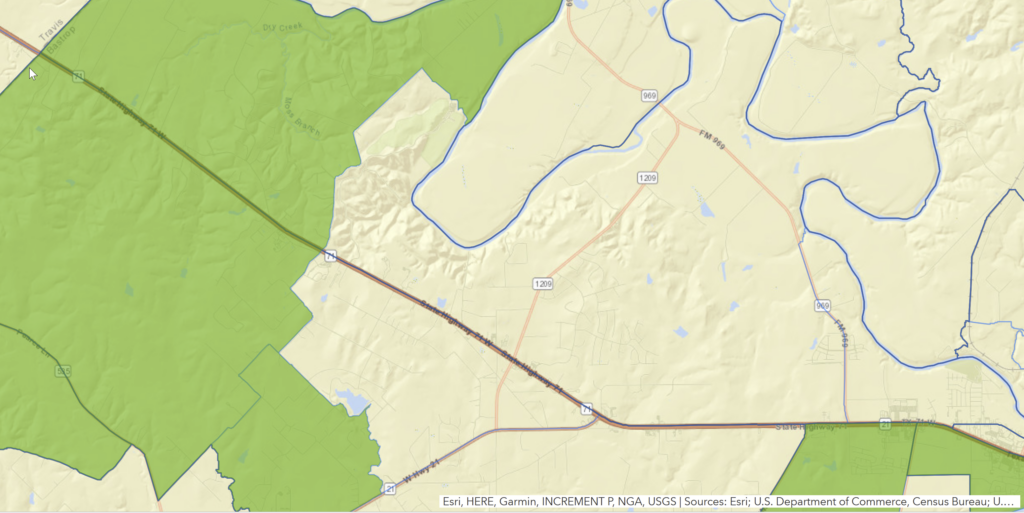
I stress “economically distressed areas” in the above description. There’s a map on the Governor’s site. Space X is not in an “economically distressed” area. Nor is Bastrop County designated as a “distressed county”. The County admits so in its “Order“.

Every application of the Texas Enterprise Zone Program to a business that is not in an economically distressed area denies those benefits to a business or county that is in such an area. Eligibility is limited according to the Governor’s website.

Then there’s the fact that this is an all-Republican Commissioner’s Court. We didn’t elect these people to give tax breaks to businesses while residential property taxpayers get slammed. The GOP Platform gives guidance on this.

So, why are they doing this? Star-struck perhaps? Because it’s Elon Musk? Perhaps it’s pressure from higher levels of government. Frankly, that would be my guess.

In conclusion, I don’t care what business owner is getting a tax break. I don’t believe in them. Redirecting the tax burden from one entity to another is socialist thinking.

I’m actually an Elon Musk fan. I don’t blame him for trying to get every break he can for his businesses. But our elected officials were put there by US, by the voters. Elon Musk, Governor Abbott, Donald Trump did not put them at the dais. We did. And they need to remember that, remember who they are supposed to represent, when voting to give another business a tax abatement.