Read Between the Lines

Original post published Feb 13, 2024. Reprinted because it’s applicable for the 2026 election cycle.

People collect things. I collect campaign literature. I have campaign literature going back probably 30 years. Some is good; some is awful; some is clever; some really, really boring. Some has colors that are just atrocious. Some was done with nary a thought for the low-vision user. Some is just evidence the candidate doesn’t know what they’re doing, or worse, why they’re running.

Campaign literature is sales literature. The candidate is selling you on why they’d be the best in the position. Here are my four rules when it’s campaign time: Don’t be fooled or swayed by photographs in the mailers; Know what the candidate can and cannot do in office; Read carefully; Find and research the legally required “paid for by”.

Rule #1: Don’t be fooled or swayed by photographs in the mailers.

Some candidates use photos of themselves with their families or children. Why? To tug at your heart strings… “Oh isn’t that cute!” Cute isn’t what you need from an elected official. Candidates need conviction and back-bone. They need to be strong, not sway the way the wind blows. They don’t need to be cute.
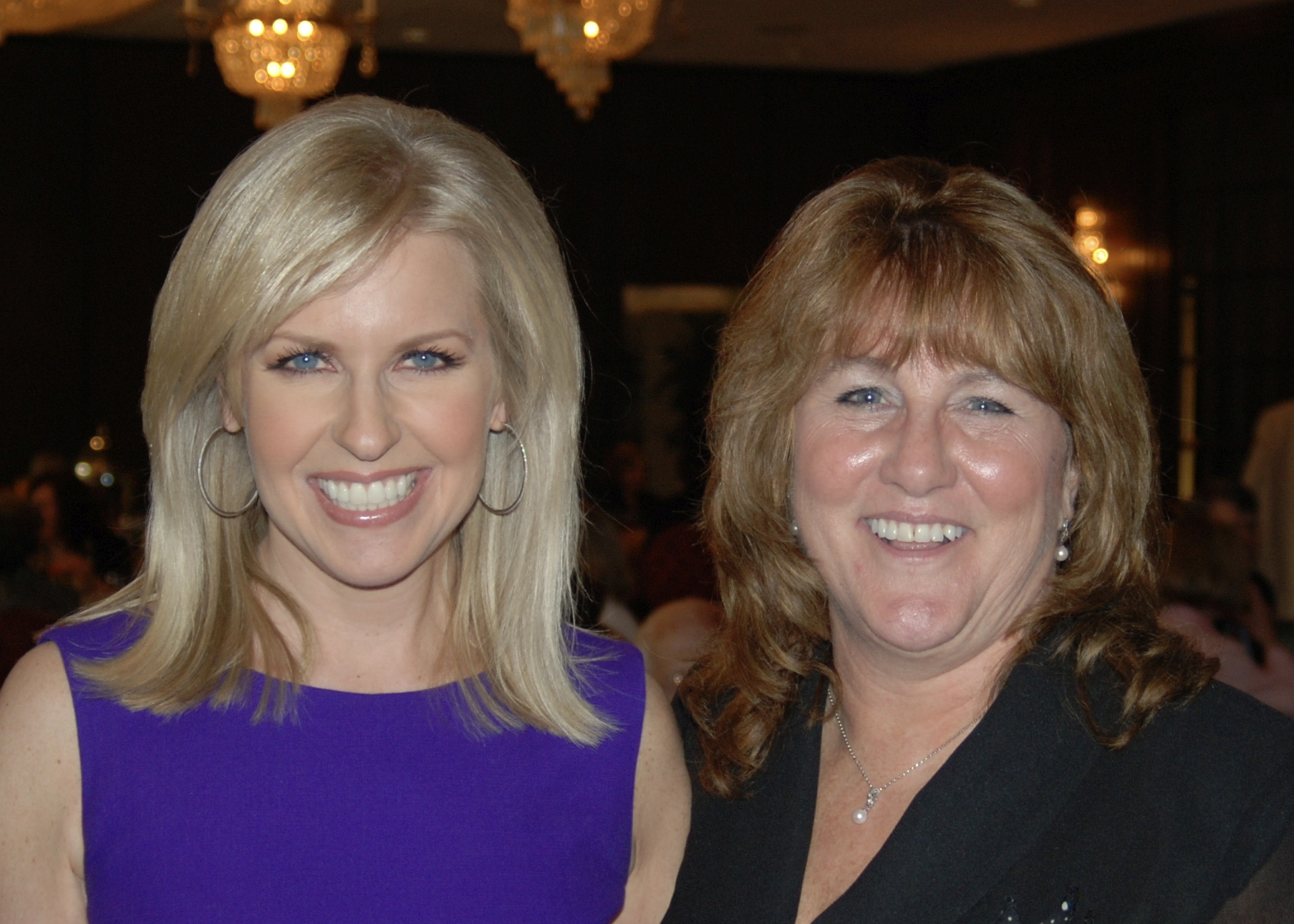
Carol Spencer with Monica CrowleyWhy do some of them use photos with famous elected officials? To make you think that person supports their candidacy. But do they? This is Monica Crowley and me a few years ago at a GOP event. Having a photo with her didn’t mean she endorsed my candidacy. The same is true of photos with Kellyanne Conway, Rudy Guiliani, Sarah Palin, Ken Paxton, Sid Miller, Governor Abbott and so many others with whom I’ve been photographed over the years. Photos with famous politicos, unless accompanied by the words “Endorsed by [name of person in photo]”, should be interpreted as manipulative, meant to make the candidate look important or to make the reader think that person has endorsed the candidate.
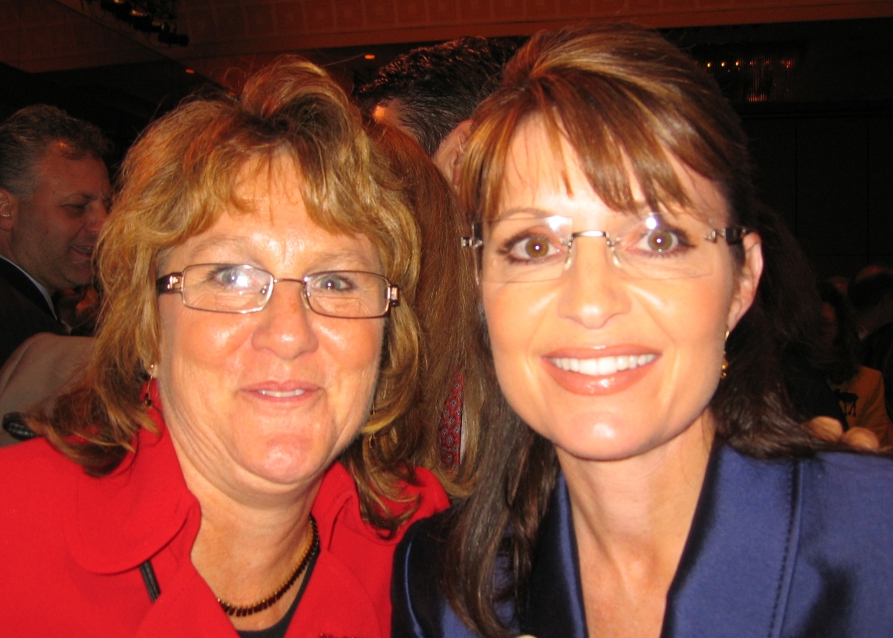
A list of endorsements by others, but not the person in the photo, when used together is pure deception. Back to top

Rule #2: Know what the candidate can and cannot do in office.

Someone running for a legislative position cannot do anything without a majority vote of the body in which they serve (city council, TX House, TX Senate, US House, US Senate). They cannot fix the border or cut government spending. And usually, the executive (mayor, governor, president) has to sign any passed legislation to make it law.

Someone running for an executive position can only do that which the charter or constitution allows. And, a great deal of what is allowed requires a vote of the legislative body: budgets, capital spending for example.

This is called “checks and balances”.

When an incumbent running for re-election says they accomplished this or that, no they didn’t. They cast one vote for legislation to make that happen. Perhaps they swayed colleagues to do the same. But in the end, without a majority vote and a supportive executive, nothing they support will ever come to pass.

And, remember what position they’re running for… a mayor cannot close the border, fund medicare or fix social security issues. A congressman can’t get local roads paved. Back to top

Rule #3: Read carefully

Beware the use of “conservative”. Does a true conservative support Democrat chairs in the legislature? Does a true conservative celebrate being endorsed by staunch Democrats? Does a conservative group endorse candidates who previously voted Democrat?

There’s a big difference between “voted to close the border” and “closed the border” but you’ll see both on campaign literature.

“Most experienced” is something else you’ll often see. If you don’t know what the requirements of the position include, how will you evaluate “most experienced”? If the person has always been a chief executive, but is running for a legislative position, that person probably does not have the requisite experience. A chief executive calls the shots. A legislator must count votes for bill passage and must sway a majority to his/her line of thinking. These are very different skill sets. Back to top

Rule #4: Find and research the legally required “paid for by”

All campaign advertisements must include who paid for them. This is critical to know. Did the candidate (well, actually, the candidate’s donors) pay for the mailer? Did some PAC (political action committee) pay for it?

If a PAC paid for it, ask yourself what that PAC expects to get for the expenditure of funds. Mailers are very expensive: design, printing, mailing costs. A county-wide GOP mailer can easily cost $5,000.

Do an online search for the PAC itself and see what it’s about. Go to OpenSecrets.org for Federal PACs and see who else got money from that PAC. Go to Texas Ethics Commission (TEC) for State PACs.

This is also true of the various emails requesting money. Where’s it going? Watch carefully. Sometimes something will appear to be for a candidate, but the money you donate is going elsewhere. Be careful! Back to top

Your Vote is Yours, not Theirs

Two years ago, I wrote a column on candidates citing their endorsements.

This year, let’s discuss the entities who make endorsements. What’s the value of those? Well, it depends.

Did the organization interview all candidates for an office?

If not, did the organization indicate that they did not?

Did the organization send a questionnaire to all candidates?

If not, did the organization state that they did not?

Did the organization provide an explanation for their choices?


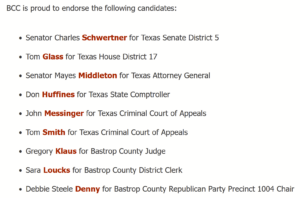
We’re going to use the email sent out from Bastrop County Conservatives with their list of endorsements as an example. The BCC website states:

Did the organization interview all “declared candidates” for an office?
BCC did not interview all “declared candidates”. If the organization didn’t interview all candidates for an office, they can’t possibly know which candidate most closely aligns with their values.

If they did not interview all “declared candidates”, did they indicate that they did not?
BCC did not indicate that they failed to interview all “declared candidates”. A simple statement under the endorsement like “We did not (or ‘We were unable to’) interview candidate A or candidate B” helps lend credibility to the endorsement.

Candidates for Texas Attorney General, Texas Court of Criminal Appeals, Bastrop County Judge, Bastrop County Precinct Chair 1004 (and possibly other races) were not interviewed or even contacted.

The list below doesn’t say that so how would voters know?

Did the organization send a questionnaire to all candidates?
BCC did not send a questionnaire. Another PAC invites all candidates for an interview. If a candidate doesn’t respond, oh well. The candidate had a chance and didn’t take it. If the candidate is non-responsive, they can’t expect an endorsement. That’s fair. Just ignoring candidates for an office, then endorsing some alleged favorite, is of no value to voters.

If they did not send a questionnaire to all “declared candidates”, did they state that they did not?
There is no statement indicating whether all candidates were interviewed or sent a questionnaire. The “process” BCC describes on their website leads the voter to believe that all “declared candidates” were interviewed. But they were not.

Did the organization provide an explanation for their choices?
BCC provides no explanation of how it decided who to endorse. There is not one sentence that explains what about a particular candidate caused them to endorse that candidate.

What good, then, are these endorsements?
None. Personally, I think voters need to know why a candidate was chosen for endorsement, what makes that person more fit for the job than any of the other candidates.

BCC (and any other PAC that provides a list without explanation) thinks GOP voters are lemmings and should just vote for whomever BCC endorses.

The conclusion of my April 22, 2024 blog post bears repeating:

Never be a lemming. Just because this group or that says “vote for our list of candidates” or worse yet, “take our list to the polls with you”, that’s not what you should do in a primary, runoff, or uniform (May non-partisan) election.

Expect information. Better yet, demand information or refuse to be a lemming. Your vote is yours, not theirs.

Come on, Candidates

Campaigning = Communicating

I don’t care if you’re a local candidate representing a county or portion thereof. I don’t care if you don’t have an opponent (yet). I don’t care if you’ve raised money or not. Have a website. Have the courtesy to communicate in some detail why you are running and what you hope to accomplish.

Facebook is not a website. Twitter is not a website. Instagram and TikTok are not websites. They are social media channels demanding short, visual posts.

Social channelsThe use of social media channels varies by age group. Who do you want to reach? Want to reach those aged 18 to 29? According to Pew Research, you should be posting on Instagram: “eight-in-ten adults ages 18 to 29 say they use Instagram”. Nearly every age group uses YouTube. Pew Research continues, “About half of U.S. adults go on Facebook and YouTube daily, 24% do so on TikTok.”
That means about half of U.S. adults do not go on Facebook. If a candidate is only on Facebook and not on YouTube, Instagram or TikTok, that candidate is not connecting with potentially 50% of voters.

YouTube and TikTok are video platforms. Short, 30 second to 1-minute videos work well. Instagram requires a photo or video to post. Every channel demands short posts.

So how can a candidate connect with the details they want to share with voters: a platform, a page for donations, a place for email signups, an appearance calendar?

A website, of course. And, in every social post, include a link to that website. Keep the domain name as relevant and short as possible. It should be in the bio / profile of each social channel so visitors can link to it.

For years, I’ve taught government officials that people want posts coming to where they live online. They’re not coming to look for you. You must go to them. And once you connect on a social channel, lead them to more detail on a website.

And please, please, please test the website and all its links on Chrome, Edge, Firefox and Safari at a minimum. Desktop percentages of use are:

Chrome71.25%
Edge10.39%
Safari8.64%
Firefox5.23%
Desktop Browser Market Share in United States Of America – October 2025

And, test it for mobile use (which is likely at least 50% of web visitors). In fact, if you can, design mobile-first. Mobile percentages of use are:

Safari49.4%
Chrome42.26%
Samsung Internet3.38%
Brave1.51%
Firefox1.44%
Mobile Browser Market Share in United States Of America – October 2025

Stats courtesy Statcounter Global Stats

This country is blessed to have elections for those who represent us. A representative republic demands an informed constituency. Candidates should have the common courtesy to inform those they expect to vote for them. A website is a necessity. It should be created before a candidate files to run. It’s the least a candidate can do to build support.

This blog post was written after looking up the websites for all state-wide and local candidates who have filed to run in the Texas GOP primary on March 3, 2026. That list will be published on LostPinesRW.club for voters to access and learn about candidates.

Election Integrity: Highest Priority

For many elections, I have served as presiding judge of the Early Voting Ballot Board, Signature Verification Committee and Central Count. This position is critical to the validity of our elections. (These committees are described below.)

I filed to run for Republican Precinct Chair in my precinct, 1008. A few weeks later, so did someone else. That made it a contested race. Contested candidates cannot serve as the presiding judge of these committees. So, I had a choice: continue to serve as presiding judge or run for precinct chair.

I chose election integrity and serving as presiding judge.

Below is the letter I sent to Justin Bezner, Bastrop County GOP Chair. I have withdrawn my name from the ballot. As I said in my letter, there are many ways to serve the Republican Party. I’ll continue my involvement through the Lost Pines Republican Women, the Bastrop County GOP Club, and when called upon, through the BCRP.

Powered By EmbedPress

What’s the “Early Voting Ballot Board” and “Signature Verification Committee”? What’s “Central Count”?

These are two groups, made up of an equal number of Republicans and Democrats, that are critical to ensuring election integrity.

Early Voting Ballot Board
An early voting ballot board (EVBB) shall be created in each election to process early voting results from the territory served by the early voting clerk. No matter what type of election an entity is having, they must have an early voting ballot board.

In Bastrop County, the EVBB also typically serves as the Signature Verification Committee, ensuring that a ballot signature matches the application. This is a critical function for election integrity.

Central Counting Station
A central counting station (“CCS”) is the place on election night where ballots are counted, vote totals are accumulated, precinct returns are completed and the unofficial elections results are generated.

Running for Precinct Chair

Ready to Serve Republicans in Precinct 1008

FOR IMMEDIATE RELEASE
September 23, 2025
Contact: Carol A. Spencer
RepublicanCarol@gmail.com

Carol A. SpencerRepublican Carol Spencer has filed for a place on the ballot in the March 2026 primary to serve as Precinct Chair in Bastrop County (TX) Precinct 1008. Spencer is currently president of the Bastrop County GOP Club. She served as a Bastrop County precinct chair from 2018 – 2022. She is a founder and past-president of the Lost Pines Republican Women. And in 2023, she was named a Texas Federation of Republican Women “Ten Outstanding”, representing the best of the best Texas Republican women.

Believing strongly in the necessity of communicating with the grassroots, Spencer started a newsletter for her precinct and later continued that communications via RepublicanCarol.org. She spearheaded a joint project, The Bastrop County Voters Guide, with the Republican Party. This guide is mailed head-of-household to all Republican households in Bastrop County. This guide contributed to Republican sweeps in each of the last two election cycles.

“Conservative values, Texas values, are the core of my political positions. I’ve brought those core values to everything I’ve done. I’ve worked hard for 35+ years for open government, smaller government, lower taxes, and operational efficiency”, Spencer stated. “My record is solid and with the votes of Republicans in Precinct 1008, I’ll continue those efforts on their behalf.”

Currently serving as Presiding Judge of the Early Voting Ballot Board (EVBB) and Central Count, Spencer is dedicated to ensuring election integrity in Bastrop County. She’s held this position for numerous elections, overseeing mail-in ballot and result count accuracy.

Spencer, a web designer by profession, created her RepublicanCarol.org blog. She designed and manages content for the websites of the Lost Pines Republican Women and the Bastrop County GOP Club. She previously authored the Bastrop County Republican Party website.

Spencer will appear on the ballots of those in Precinct 1008 in the March 3, 2026 Republican primary.

Carol Spencer can be reached via email at RepublicanCarol@gmail.com, on X (formerly Twitter) as @RepublicanCarol, on Gettr as ChazTX, on Facebook at FB.com/RepublicanCarol.


Bills Wither and Die on the Vine

To get to the Governor for signature in order to become law, Texas bills originating in the Texas House must be assigned to a committee, must have a hearing and be voted out of that committee, must be assigned to a calendar by the Calendar Committee and then must pass on the House floor.

In my business (IT), we would call every one of these a possible point of failure. But those aren’t the only ones because after passing the House, a bill goes to the Senate and the same process happens all over again.

So, last Thursday at midnight, any bill that originated in the House and hadn’t yet had a floor vote was effectively dead. DEAD. And, that night, many bills died. Texas also has a rule that bills are all single subjects, so thousands are filed each session.

Wondering how the list of bills authored or sponsored by HD-17 Rep Stan Gerdes faired? I can tell you that the one I’ve pushed now for two sessions never made it beyond committee assignment. Apparently, it found its way pretty quickly to the circular file again this session. Developers don’t want it and they have far more influence (and money) than we citizens do.

But here’s an article about a few possible (possible because they’ve not yet been signed by Gov Abbott) wins for Rep Gerdes: https://www.kbtx.com/2025/05/18/most-bills-die-texas-house-deadline-heres-what-brazos-valley-lawmakers-secured/

Eventually, I’ll post about the status of his various bills. That’s hours of work so it won’t happen before the end of the legislative session. Oh, did I mention that’s a mere 13 days away? Sine die, the end of the session, is on June 2.

It sure doesn’t look like a great session for Republicans, but then again, many of us predicted that when the Speaker vote shenanigans took place. See also: The Poison Pill, No Dem Chairs Vote Rings Hollow, and The Clock is Ticking.

J6 Choir: Let’s be Very Clear

Let’s be VERY clear about the J6 Choir controversy the Democrats used to delay the vote for Kash Patel as FBI director. Let’s be VERY clear.

The J6 Choir video that the Judiciary Committee Democrats are SO opposed to is one of incarcerated J6ers singing the National Anthem while President Trump cites the Pledge of Allegiance. The Democrats have now clearly shown their true colors. Shameful.

Watch the video that they object to, the patriotic video that they want to use to deny Kash Patel, a highly qualified individual, the Directorship of the FBI. Shameful.

These Democrats want to deny Kash Patel the Directorship of the FBI, but they were fine with these people serving in the Biden administration. Democrat Party Judiciary members have gone nuts and clearly shown themselves for the kooks they are.